
by Mark Oppenheim
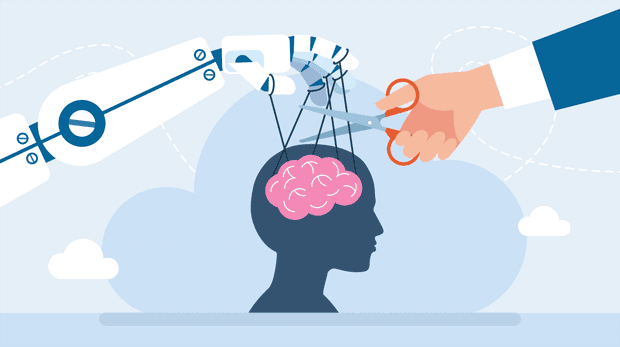
Let’s discuss the negative impact of reliance on tech that “disappears” nonprofit orgs and candidates unless they pay.
We’re all forced into the “play or die” trap so often seen in computer games. It’s a soft version of a mafia-type protection racket: “…nice little career you’ve got going here – it would be a shame if you were invisible …” and then we’re offered the “option” to click, post or pay a fee. Nonprofits are receiving AI-generated emails that imply (or state outright) that AIs will make them invisible to funders, audiences, clients and their communities unless they pay. The tactic is used because it works.
We all click, post and pay up, one way or another. But maybe we shouldn’t… at least not as much.
Enshittification
“Enshittification” is the impolite term coined by Cory Doctorow to describe what happens when financial incentives for tech companies are aligned to making things worse not better for their platform’s users, and enshittification of the visibility economy is harming nonprofit orgs and careers.
To visualize what’s going on, look at how behavior is manipulated by platforms… for example by click-intensive games, addictive gambling sites and social media. The apps start easy and free to hook us. Then various incentives increase our views and clicks as we’re fed little serotonin treats and socialized into thinking that clicking benefits us. We get rewards – prizes, data, etc. Much of what we’re fed is hollow, but awards are just enough to keep us online. We pay with time and money, they give us our treats.
As we become increasingly hooked, the process is made more profitable by cutting underlying costs. Quality suffers. Truth becomes unimportant. Is it real? Who knows… who even cares? If something is more likely to grab attention and hook us, then that’s what we’re shown… and it’s cheaper to not care about truth or accuracy. AI content creation and its use as a 24/7 monitor and manipulator of our behavior is a godsend for these platforms.
The best nonprofits and the most dedicated professionals can’t play this game the way it’s designed to be played. The best are the best because they work in the real world and are not just clicking away. Our challenge is that online visibility tilts toward clickers & payers. The doers? Not so much.
The vain hope of clickers (and I’ve been one) is that some black-box algorithm will give us a complete picture of truth, work in our interest, and help us as we compete with everyone else being served by the same platforms. But in the end it all feels manipulated and even counter-productive. So here are a few guidelines shaped to the needs of nonprofits and their leaders as they navigate the visibility economy.
1) Cultivate a healthy level of tech distrust and use the 5% rule.
Spend 85% of your workday getting stuff done, 10% on networking and exchanging information with real people via Zoom & phone, and only about 5% of time working just online through platform intermediaries. This includes when you’re on a job hunt or hunting for talent. Instead of just posting and submitting applications (“please please please see me”), call and try to connect with people able to give you more information and answer some questions. In Nonprofit Land it isn’t all that hard to do.
Even if your outreach is rejected and you are re-directed to a platform, call anyway. With time you’ll be surprised with what you’ll learn from rejection and how you’re treated, what those willing to engage will tell you, the relationships you’ll form, and the new thinking you will develop. Sounds easier said than done? It is… but that’s because we’re all out of the habit of having normal human interactions with strangers who are busy. Go the extra mile and tough it out – you’ll strengthen skills and gain valuable insight into yourself and others.
2) Don’t pay people functioning as tech’s human face.
Across the visibility economy all sorts of people are being incentivized and co-opted into functioning as the human face for AI-executed work. We see this in financial services, recruiting, accounting, and other professions tech companies are targeting for takeover. Firms large and small are falling in line, with even senior execs performing work as sales frontends to platforms. You don’t need to be paying a premium for that kind of thing.
Tech has a place, particularly when underlying data used to train an AI is known, of high quality and contextualized, and when the model’s logic is actually controlled by users for their specific purpose. This isn’t usually what is going on under the covers because that use of AI is tailored and out-of-sight expensive. Without that, these systems encourage mediocre to poor management decisions while generating lots of time-sucking data and activity. Don’t fund a human interface to a platform. Don’t be diverted by data volume over quality. Don’t fall for an illusion that will later require fixing.
3) Always be ready to switch or leave particular tech platforms.
Switching among tech platforms can save time and money, improve outcomes, and it avoids your being captured by any one way of thinking and acting. We’ve all left platforms: how many of those do we really miss?
4) Only grant platforms access to essential information.
Post high level information only; require in-person contact to exchange detailed information. That way you can verify the data you receive, and you can verify that what you are sharing is being used as you intend. Ensure that you understand the context of the other person’s need. Take the opportunity to listen to them and form a more distinctive relationship. This process limits a platform’s ability to use us as their tool for manipulating and extracting information from others, and it shifts the balance of power toward people.
Assume that anything entered into a platform database will be shared broadly and monetized beyond your ability to control who sees the information and how they use it. This is inevitable. You can only control how much information they have, how old their information is, and how easy it is to use that data without you. Trickle out your data and always make them come back to you for more. Don’t believe it when platforms imply that you need to give them everything.
5) Communicate with real people (not nodes in a dataset) through multiple channels and as directly as possible.
Direct communication with people is ALWAYS better than going through tech platforms. The platforms make a profit by placing themselves between you and your targets, and then driving visibility bidding wars, employee turnover and various types of churn. They use information harvested from your interactions on and through their platforms to do this. You can reduce damage by exercising control over information, and by communicating directly with others where possible.
Here’s a story for you –
All my grandparents were immigrants who started poor and never became wealthy. They all needed work, and to get jobs they needed to be visible. They had no money to pay for visibility. What did they do?
They knocked on doors.
They formed relationships. They built community with those who might need them. They asserted value. Sometimes they did that successfully and could work. When they worked, they worked HARD. Sometimes they were not successful, but they persisted and their persistence paid off. They built careers, businesses and organizations, and they found employers, employees, customers and funders. Your family can tell the same story.
Tech is a tool, not reality. Be real. Reach out to people, brave rejection and persist. Don’t be made helpless by tech that has us bidding against one another for vaguely defined access to a user base and algorithms tilted in ways you don’t understand. Directly contact those you want to serve.
—
Knock knock…