
By MELINA WALLING Associated Press
DYSART, Iowa (AP) — When Al Schafbuch cut back on plowing his Iowa fields decades ago and later began
growing cover crops, he was out to save money on fertilizer and reduce erosion. He got those benefits
and saw his soil change for the better, too: dark, chunky, richly organic matter that he said feels
like “chocolate cake.”
There’s one more big payoff that benefits everyone: tilling the soil less, and growing more cover
crops, can help farmers store more planet-warming carbon in fields. More plants take in more carbon
dioxide, and soil microbes breathe out less carbon when undisturbed. That can mean money for
participating farmers in the form of carbon offsets — payments that companies can make that support
carbon storage in farms and, in theory, balance out their emissions elsewhere.
“The more carbon you store from the atmosphere with your crops, and the more crops grown throughout the
year, you offset some of your waste, your wasted energy,” said Shalamar Armstrong, an associate
professor of agronomy at Purdue University. “Because you’ve stored carbon that would have been emitted
(into) the atmosphere.”
It’s an area getting more attention from lawmakers, researchers and industry professionals. The U.S.
Department of Agriculture this week announced a $300 million investment to monitor agricultural
emissions, including by creating a research network to monitor carbon in soil. And U.S. Sens. Tina
Smith, D-Minn., and Todd Young, R-Ind., introduced a bill that Smith said would support the research
needed to “properly credit soil carbon storage.”
The USDA announcement and the legislation are both aimed at the difficult question of how to quantify
carbon stored in soil. It’s an obstacle to overcome if the young and booming soil carbon market is to
avoid the scrutiny, and skepticism, directed at carbon credit markets.
“The science piece (of carbon credits) has really lagged behind, particularly when it comes to things
like monitoring, reporting and verification,” said Cristel Zoebisch, deputy director of policy at
climate organization Carbon180. “These are huge obstacles for not just soil carbon sequestration, but
really any land-based carbon removal solution.”
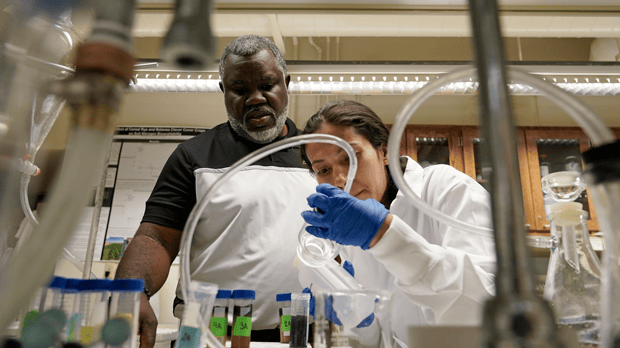
Armstrong has been trying to help fix that problem. He runs a lab where researchers are investigating
how farming management affects the amount of carbon in soil across different landscapes. He and others
at Purdue have been studying soil samples that date back more than 40 years, comparing different types
of tilling and cover crops to determine their long-term effects on carbon storage. It can take years of
fieldwork, careful chemistry in the lab and lots of expensive equipment to puzzle that out.
He hopes his precise calculations will help farmers make decisions that allow them to receive
worthwhile incentives for sequestering carbon while maintaining their existing profits.
But other academics worry that even if farmers do get paid for storing soil carbon, it won’t solve a
bigger problem: that carbon markets often don’t work.
For offsets to be legitimate, they have to meet four criteria. They have to store carbon that would
otherwise be emitted; they have to be verifiable in data; they have to be immediate (planting a tree
that might grow up in 20 years doesn’t cut it); and they have to be long-lasting, said John Sterman, a
professor of management at Massachusetts Institute of Technology.
Better quantifying soil carbon storage through research might make the offsets more verifiable, but it
doesn’t address other factors. For example, many farmers rent the land they work, and can’t guarantee
that carbon stored on their land will stay put in several decades if someone else is working the land.
Barbara Haya, director of the Berkeley Carbon Trading Project at University of California, Berkeley,
has worked on research that she said shows the effects of carbon offset projects are commonly
overestimated, sometimes vastly so.
“Carbon trading is a mechanism that has failed miserably over the last 20 years that we really need to
be moving away from,” Haya said.
U.S. Rep. Jared Huffman, D-Calif., last month introduced a bipartisan bill to support farmers in
improving soil health, with incentives that don’t necessarily involve the carbon market. He said
farmers in his district have also described the benefits of regenerative practices, and that many would
be interested in participating in carbon markets with “robust” accounting systems. But he added that
those hoping for serious climate action shouldn’t rely only on offsets.
“In my opinion, it’s really not the silver bullet,” Huffman said. “I think offsets are inherently
sketchy.”
Some farmers are moving cautiously.
Brad Wetli, an Indiana farmer who collaborates with Armstrong, has been trying techniques that use less
tilling and has been planting cover crops like rye for a few years now. He’s happy with the way his
current fields look — “It feels like you’re doing something” to contribute to sustainability, he said —
but he’s still weighing his options with possible carbon credit contracts, doing the math and waiting
to see whether the price will be right, since many offset agreements can last for several years.
“I’m going to do maybe a field or two at a time, and as I learn more, I’ll hopefully incorporate the
carbon or carbon credits more into the operation,” he said.
Schafbuch, for his part, is skeptical of carbon credits but would have been enthusiastic about
regenerative farming no matter the upfront costs. He said he was an early adopter in the face of
neighbors who laughed and suggested he would “end up being broke” — but he’s proved them wrong.
“I’m convinced that if you do it right, anybody can do it,” he said.
___
This story has corrected Cristel Zoebisch’s organization to Carbon180, not Climate 180.
___
Associated Press journalist Joshua Bickel contributed to this report from Fowler, Indiana.
___
Follow Melina Walling on Twitter @MelinaWalling.
___
Associated Press climate and environmental coverage receives support from several private foundations. See more about AP’s climate initiative here. The AP is solely responsible for all content.